
In Class 10 Science Chapter 8, we learn about Sexual Reproduction in Plants. This chapter explains how plants reproduce sexually through flowers, pollination, fertilization, seed formation, and fruit development. Understanding these processes is important for students to grasp plant biology and prepare for exams.
Sexual Reproduction in Plants:
The process of sexual reproduction in plants involves the development of a new organism through the formation of male and female gametes either by same or different plants. It is the flower where the sexual reproduction in plants mainly occur.
Main parts of a flower- Receptacle, Sepals, Petals, Stamen and Carpel.
Petals– They are colorful and therefore attract the insects for pollination and they also protect the reproductive organs.
Stamen- The male reproductive part (organ) of a flower. A flower has a number of stamen in it.
.At the top of the stamen, the anther is located, and pollen grains are produced there.These pollen grains contain the male gametes.
Carpel- The female reproductive part (organ) of a flower.We can also call it the pistil.
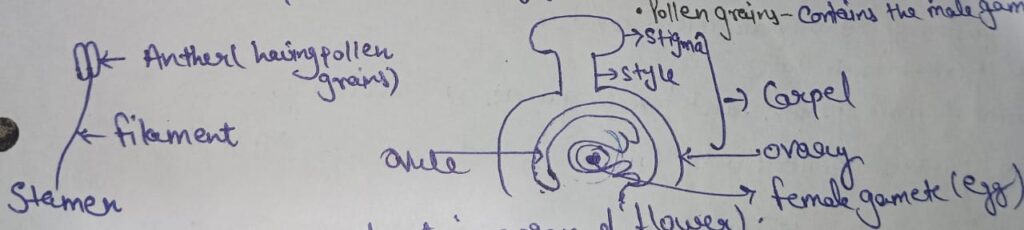
- The flowers which contain only one sex organ (either stamen or carpel) are unisexual flowers. For example: Papaya and Watermelon.
- The flowers which contain both carpel as well as stamen are bisexual flowers. For example: Hibiscus and Mustard plants.
Process of Sexual Reproduction-
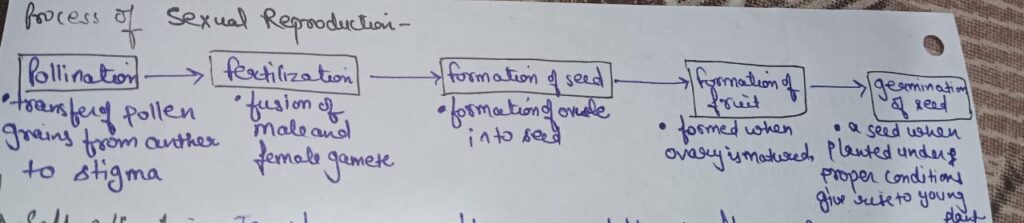
- Self Pollination- Transfer of pollen grains from anter to stigma of same flower or maybe the different flowers of same plant.
- Cross Pollination- Transfer of pollen grains to different plants of same species.
- Agents of pollination- Wind, water and animals ( for example: insects, birds, bats etc.).
Sexual Reproduction in Plants: Fertilisation (Pollen-Pistil Interaction)-
When a pollen grain falls on stigma (which is sticky), it bursts open and grows a pollen tube1 downwards through the style towards the female gamete in ovary. Through which male gamete moves down and the pollen tube enters the ovule in ovary(through micropylar end).
The tip of pollen bursts open and it meets the female gamete (egg) to form a zygote which further divides to form an embryo.
- Pollen tube grows due to chemical interaction between pollen and stigma. ↩︎
Note- when the pollen reaches the embryo sac or ovule, the nucleus of pollen grain divides on its way to form two male gametes.
- One male gamete fuse with female gamete to form zygote(2n). This fertilisation is called syngamy.
- Second gamete fuses with another cell (polar nuclei) to form endosperm(3n) which provides nutrition to embryo. This fertilisation is called triple fertilisation.
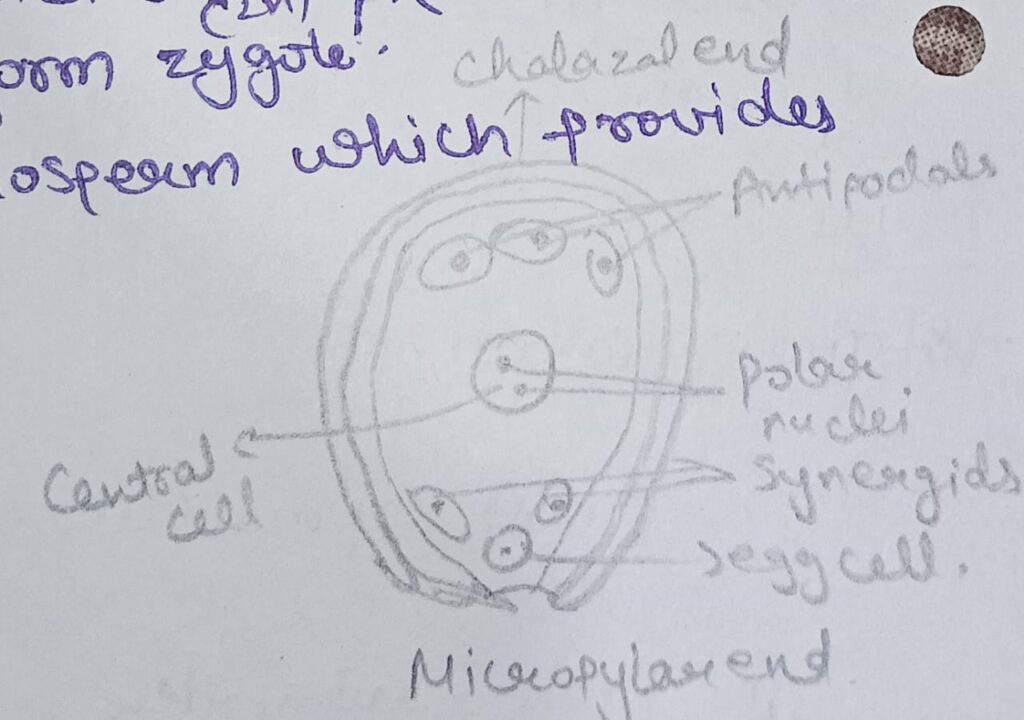
Sexual Reproduction in Plants- Double Fertilisation
- The fusion of two polar nuclei and male gamete is called triple fusion.
- The fusion of male and female gamete is called syngamy.
- These two fusions collectively known as double fertilisation.
Post Fertilisation events:
After fertilisation, embryo divides mitotically to form multicellular embryo. The endosperm nucleus divides to form a mass of endosperm cells to provide nutrition to developing embryo. The ovary develops into a fruit, and the ovules develop into seeds.The other parts of the flower dry up and fell off.
The fruit protects the seed. The seed is the final product of sexual reproduction. Seed comprises of seed coat, cotyledon and embryonal hub. The seed is the reproductive unit of a plant.
The seed contains a baby plant and food for it but in the dormant state. When it gets suitable conditions like water, air and warmth etc. it germinates to form a new plant.
The part that grows into shoot known as plumule and the part with roots is known as radicle.
Germination of seeds- The germination of seeds is called the beginning of their growth when suitable conditions are provided.
Download NCERT Class 10 Chapter 8 PDF on how do plants reproduce sexually
https://ncert.nic.in/textbook.php
These notes on Class 10 Science Chapter 8 – Sexual Reproduction in Plants summarize the key processes from flower structure to seed formation, helping students revise efficiently.
For Asexual reproduction of plants, you can click on the link given below
One thought on “Class 10 Science Chapter 8 Notes – Sexual Reproduction in Plants”