
Reproduction in animals is one of the most fascinating and important topics in the Class 10 CBSE curriculum, as it helps us understand how life continues from one generation to the next.
Most of the animals reproduce sexually but there are a few animals ( for example:Komodo Dragons, Starfish, Whiptail Lizards, Python Snakes, Marbled Crayfish etc.) reproduce asexually.
Sexual Reproduction is the process where two organisms ( male and female) combine their genetic material to form a offspring.
Gametes- Gametes are the cells that take part in sexual reproduction.
Male gamete– Sperms
Female gamete– Ovum/Egg
Fertilisation is when the male gamete and female gamete fuse to form a zygote during sexual reproduction.
Internal Fertilisation- Fertilisation that takes place inside the female body. For example: humans, dogs and birds etc.
External Fertilisation- Fertilisation that takes place outside the female body. For example:(common in aquatic animals) fish, starfish and amphibians like frog etc.
- Here, in external fertilisation, the female parent deposits the eggs in a place and later, the male parent ejects his sperms over them and then fusion takes place.
- Gametes that fuse externally have to face many challenges. Since animals deposit gametes in the external environment, the chances of their fusion are very low. Predators may eat the eggs or the zygote that forms. As a result, they lay a hundred of eggs at a time.
Viviparous and Oviparous animals:
The animals who deliver well developed babies are Viviparous( for example: Dog, cat, humans) while the animals who lay eggs are Oviparous (for example: Lizard, crow, hen etc.)
- There are some animals in which the female retains eggs inside the body (after fertilisation) and allows the development of embryo inside the body. No extra nourishment is provided to developing embryo as placenta is absent. for example: sharks, insects etc. Therefore, such animals are called ovoviviparous animals.
- Sexual reproduction leads to a greater variety in population which leads to higher chances of survival as they can adapt ore quickly to surroundings.
Puberty-Puberty is the age at which sexual maturity occurs and the sex hormones begin to produce.
- On attaining puberty(13-14yrs), the male gonads (testes) start producing male gametes (sperms) and female gonads (ovaries) start producing female gametes (egg) and also stat secreting sex hormones.
- Sex hormones in males- Testosterone and in female- oestrogen and progesterone.
Before we dive into male and female reproductive system, you might want to check asexual reproduction in plants https://learneasywithk.in/class-10-science-chapter-8-notes-how-do-organisms-reproduce/ and sexual reproduction in plantshttps://learneasywithk.in/class-10-science-chapter-8-sexual-reproduction-plants/
Male Reproductive System:
In humans, it is located in the pelvic region and includes a pair of testes, scrotum, vas deference, urethra, two sperm ducts, penis and some accessory glands.
- Testes- The testes are oval-shaped organs that lie outside the abdominal cavity of a man in a small muscular pouch called the scrotum..Testes produce sperms, which needs a temp of about 2-3 degree celsius below the body temp and scrotum provides it an appropriate temp for optimal sperm production.
- Epididymis- Along the inner side of each testis lies a mass of coiled tubules called epididymis. Here,The body temporarily stores the sperm cells for maturation after producing them.
- Accessory duct system- From each testis,originates a short tube called vas deference that goes up into the abdominal cavity. It transfers sperm cells from epididymis to the urethra. Urethra in the penis receives both sperms and urine.
- Secondary glands- The special glands that pour their secretions into the urethra and these secretions are essential for the nourishment and mobility of sperms. The fluid mixture that contains the secretions of these glands and sperm is what we call semen.The glands are-
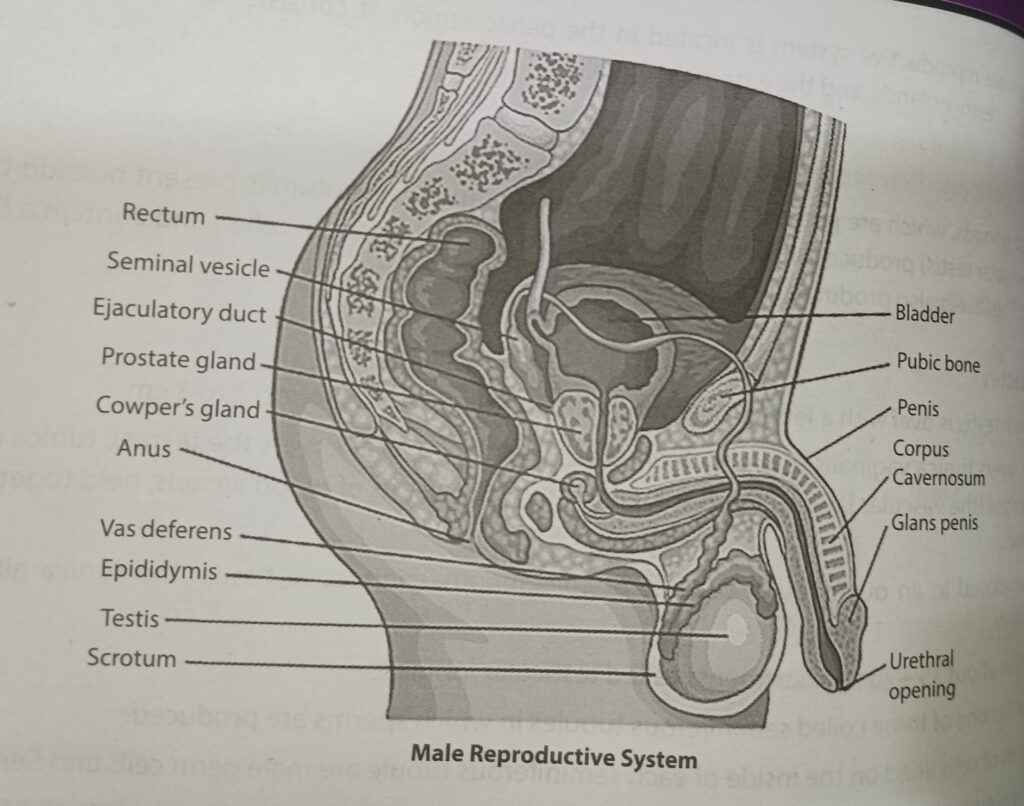
(i). Seminal vesicles-There are two glands present behind the urinary bladder. Its main function is to secrete seminal fluid that increase the mobility of sperms.
(ii). Prostate gland- It is located just below the bladder. Its main function is to produce the fluid that nourishes and transports sperm and pour into urethra.
(iii). Cowper’s gland- They are located beneath the prostate gland. These are two pea-shaped glands that add fluids and mucus to semen during ejaculation to lubricate the urethra.
Secretions of the above glands have the seminal plasma which contains fructose, calcium and certain enzymes.
Female Reproductive System:
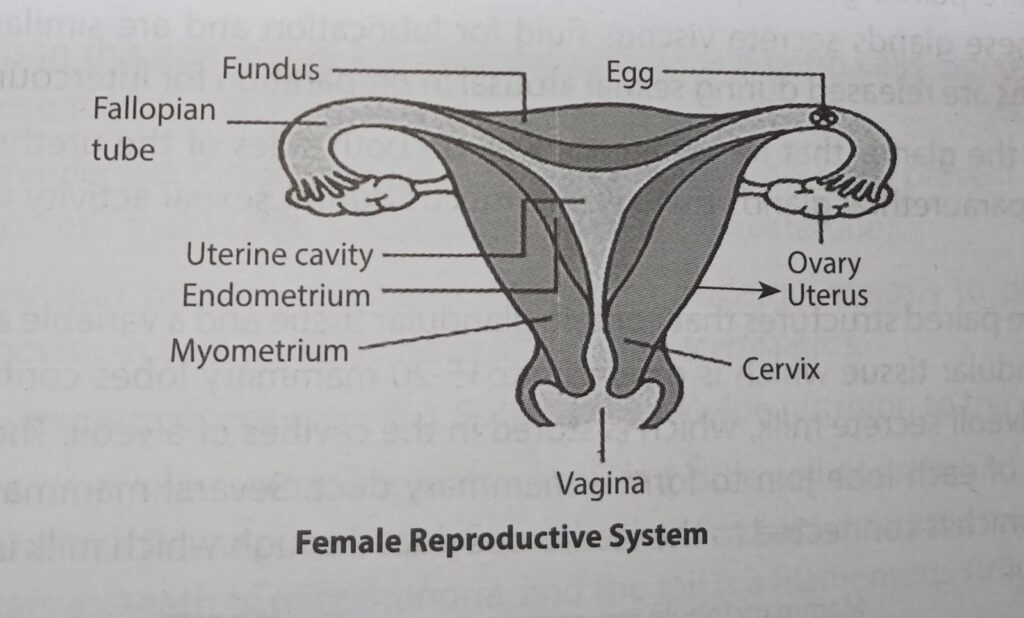
The female reproductive system in humans consists of a pair of ovaries, along with a pair of oviducts, uterus, cervix, vagina and external genitalia which is located in the pelvic region.
- Ovaries are located in the abdominal cavity near the kidneys. A ligament connects each ovary to the uterus. The ovaries develop ovarian follicles, which later form female eggs. They also directly or indirectly secrete the hormones progesterone and estrogen.
- Fallopian tubes- These are two tubes, one on each side near the ovary. They have a funnel shape with finger-like projections Called fimbriae opening to receive the eggs as they mature. If sperms are present, fertilization takes place here.
- Uterus- Fallopian tubes open into a thick-walled muscular organ called uterus.The embryo implants in the uterus, where it develops as a foetus for nine months. The lower tip of the uterus is called the cervix.
- Vagina- It is the opening of a uterus into a narrower tubular structure. Sperms enters through Vagina and it serves as a birth Canal during birth of a child.
- Female Accessory Glands-
(i) Bartholin’s glands- These are paired glands, with one located on each side of the vaginal opening. These are similar to the cowper’s gland and secrete viscous liquid for lubrication.
(ii) Glands of skene- These are similar to the prostate gland that secrete mucus.
(iii) Mammary glands- These are paired structures in females that contain glandular tissue and varying amounts of fat. They have alveoli which secrete milk.
Menstrual cycle-
During the menstrual cycle, the body breaks down and removes the inner thick, soft lining of the uterus along with its blood vessels, causing vaginal bleeding called menstrual flow or menstruation.
- Menstrual cycle is complex and is controlled by many different glands and hormones.
- Hypothalamus causes the pituitary gland to produce certain chemicals which give the signal to ovaries to produce estrogen and progesterone.
- The menstrual flow which begins at puberty is known as menarche.
- The pause of menstrual cycle between the age of 45 to 55 yrs is called menopause.
Phases of menstrual cycle-
- Menstrual phase: If the egg does not get fertilized, the uterus sheds the lining it prepared for implantation. This shedding lasts 3 to 5 days and is called menstruation. The menstrual fluid contains blood, cells from the uterine lining, and mucus.
During the cycle-
(a) Lueteinizing hormone (LH) reduces (hormone that triggers important processes in your reproductive system and is important for pregnancy).
(b) The corpus luteum degenerates, and the production of progesterone and estrogen usually decreases.
2. Follicular phase or proliferative phase: This phase starts on the last day of menstruation and ends with ovulation. Prompted by hypothalamus, the Pituitary gland releases two hormones follicle stimulating hormone (FSH) and LH. This hormone stimulates the ovary to to produce around 5 to 20 follicles which bead on surface. Each follicle has an immature egg. Out of which, usually only one follicle will mature into an egg while others die.
3. Ovulatory phase: This is the phase in which ovulation takes place. Ovulation is the release of a mature egg from the surface of ovary. This usually occurs mid-cycle, around two weeks or so before menstruation starts. During the follicular phase, the developing follicle causes a rise in the level of estrogen which causes a release of chemical called gonadotrophin releasing hormone (GnRH)and LH and FSH.
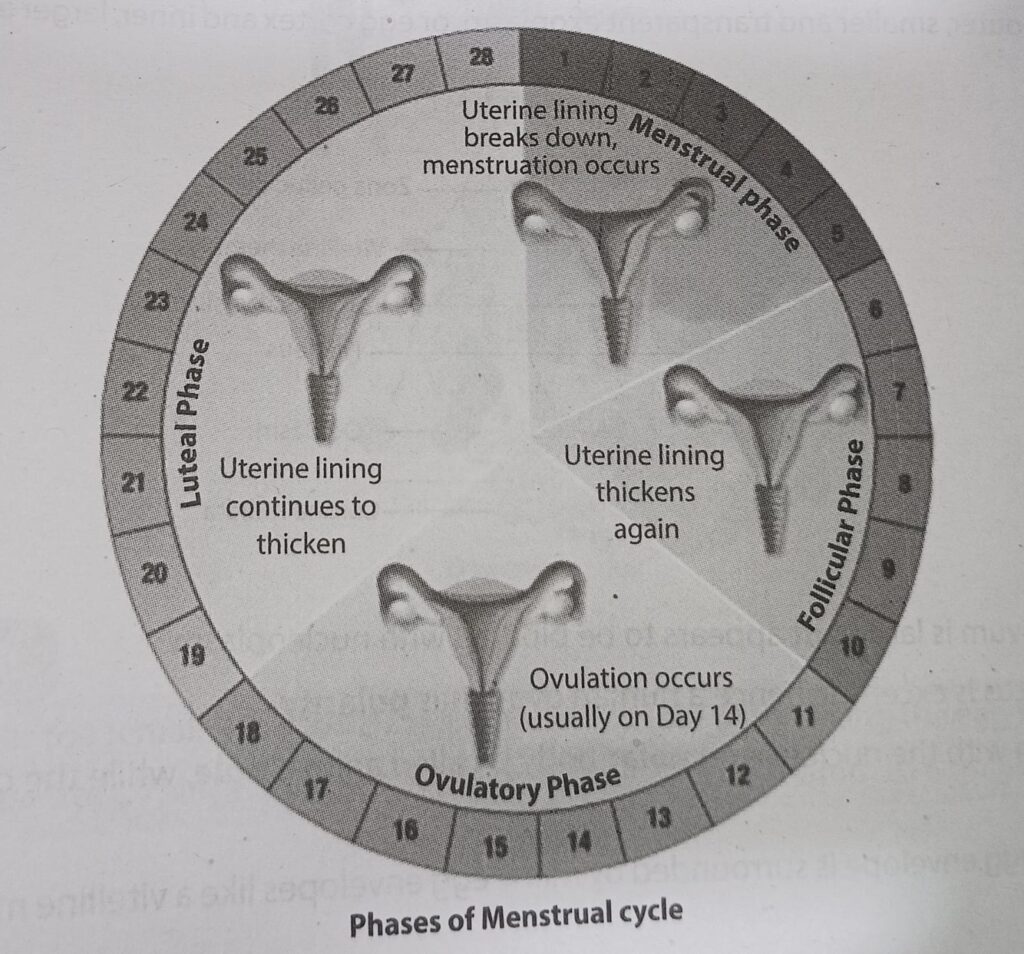
4. Luteal phase or secretory phase: This phase lasts from 14th day to 28th day. After ovulation, the uterus lining thickens further. The follicle ruptures and forms a yellow body called the corpus luteum, which releases the hormone progesterone and causes several changes in the womb.
- The combination of hormones maintains the thickened lining of the uterus, waiting for a fertilised egg to stick (implant).
- If a fertilised egg implants in the lining of uterus, it produces necessary hormones to maintain corpus luteum. This includes the hormone human chorionic gonadotrophin (HCG), which a urine test detects to confirm pregnancy.
- If pregnancy doesn’t occur, the corpus luteum withers and dies. The drop in progesterone level causes the lining of uterus to fall away.
PCOD:
Polycystic ovarian disease is a hormonal condition that affects female when the hormones of a woman go out of sync. This condition can cause problems like irregular periods, infertility, and acne. If left untreated, it can also lead to serious health issues such as heart disease and diabetes.
Implantation:
The embedding of embryo in the thick lining of uterus is called implantation.
- Once the implantation takes place, the fertilised cell mass or embryo starts showing the triploblastic nature of human beings by dividing and forming three layers of cells- ectoderm, mesoderm and endoderm. These layers give rise to different organs during development.
Placenta:
The placenta forms a physiological connection between the embryo and the mother’s uterine wall. Through it, nutrients and other useful substances pass from the mother’s blood to the foetus, and the foetus releases waste products like urea and CO₂ into the mother’s blood.
- The human placenta consists of both maternal tissue and tissue derived from embryo.
- The placenta releases hormones like placental lactogen and relaxin, which the foetus needs for its growth.
- The Umibilical cord arising from the embryo’s abdomen serves a link between embryo and placenta.
Gestation:
The gestation period, or pregnancy duration, is the time the foetus takes to fully develop, from conception to the birth of the baby.
Parturition:
It is the process of contraction of the uterus at regular intervals at the time of delivery which is helpful for expelling the fully grown foetus from mother’s uterus.
Lactation:
It is the process of production of milk by mammary glands at the end of pregnancy. The mother produces milk called colostrum in the first few days. It is thick, sticky, and yellowish, and it gives the baby initial immunity.
Artificial modes of fertilisation: (IVF-In Vitro Fertilisation)
- IVF involves a doctor extracting eggs and sperms and fertilising them in a special laboratory set up for a few days. If fertilization occurs, doctors let the zygote develop for about a week and then place it in the mother’s uterus, where it completes its development.
- Doctors use this technique for women whose oviducts are blocked.
- Doctors call babies born through this technique test-tube babies because fertilization happens in special test tubes..
Download NCERT Class 10 Science Textbook