
Hello students! Here are the summarized notes for Chapter 8: How Do Organisms Reproduce.
Reproduction In Plant:
- Reproduction is the process of producing new individuals of the same kind.
- An organism does not need it to survive; however, it uses it to produce offspring.
- It is mainly of two types :- Asexual and Sexual.
- Difference between Asexual Reproduction In plants and Sexual Reproduction In plants
| Asexual Reproduction | Sexual Reproduction |
| In this type of reproduction, no fusion of gametes occurs i.e only one parent is involved. | In this type of reproduction, two parents bearing gametes of opposite sex are involved. |
| No variation of genes occurs as the full set of genes are transferred from parent to offspring. | Here, fusion of gametes occurs. |
| Usually seen in unicellular organisms or lower grade multicellular organisms. | Usually seen in higher plants or animals. |
Asexual Reproduction In plants:
Types of Asexual Reproduction:
1.Fission– In this, a unicellular organism splits to form two or more new organisms. As a result, here are the subparts of fission:
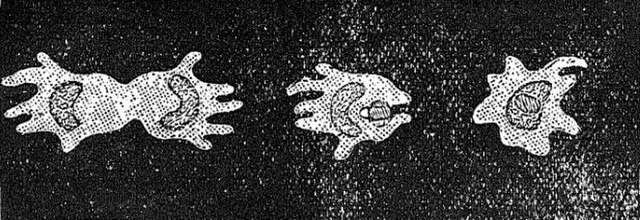
i).Binary Fission– The unicellular organisms for example: Amoeba, Euglena, Paramecium and Leishmania( causative agent of kala azar) etc reproduce by binary fission.
Binary fission in Amoeba
Eg. Plasmodium (causes malaria , vector-female anopheles), Algae and Yeast etc.
ii).Multiple Fission– This means that the organism splits to form many organisms at the same time.
Sometimes, in this type of fusion, a unicellular organism forms a cyst with a protective wall. Inside the cyst, the nucleus divides into many nuclei, and along with some cytoplasm, forms numerous new daughter cells. When the cyst breaks, it releases the daughter cells.
2. Fragmentation– In this, the body of the parent organism breaks into two or more distinct pieces, such that each fragment can develop into a new organism. For example: Spirogyra, Sea Anemone, Flatworms.
This occurs in simple multicellular organisms. Such that there must be a single cell type in an organism that is capable of growing,proliferating and making other cell types under the right circumstances.
3. Regeneration– Special cells help an organism grow back its body parts through a process called regeneration. For example: Hydra, Planaria and Starfish.
In this type of reproduction, the organism breaks into many pieces, and each piece grows into a new individual
Note:–Multicellular organisms can not regenerate its body parts as they have complex specialised cells that make up the tissue, tissues make up organs, organs make up organ system and finally make up an organism.
4.Budding– In this, a bulb-like projection called bud occurs on the body of the parent organism. The bud increases in size and eventually breaks off from the parent and develops into a new individual. For example: Hydra, Yeast and Spongilla.
5.Spore Formation– In this, the parent plant produces hundreds of microscopic reproductive units called ‘spores’. When the spore case of a plant bursts, then the spore bursts into air. When these air borne seeds land on food or soil under favourable conditions, they germinate to produce new plants. For example: Rhizopus and Penicillin.
Reproductive part of rhizopus– Sporangia(bulb like structure)
Non- Reproductive part of Rhizopus– Hyphae.
6.Vegetative Propagation–In this method, new plants grow from the stems, roots, or leaves of old plants without using any reproductive organs.
There are two ways by which the plants reproduce by vegetative propagation- naturally and artificially.
Natural Methods–
(a) Modified Tuberous roots- There are few roots which apart from providing support and absorbing water and minerals, also store food and thus take part in vegetative propagation.
Eg. Tuberous roots of Dahalia, Sweet potato, Asparagus become swollen due to food stored in them.
(b) Propagation through stems- Different types of stem modifications are-
- Tubers-Some plants have underground stems called tubers, which swell because they store food. Tubers possess scars or depressions called ‘eyes’. Each eye represents a node in which small buds are present. Consequently, these buds give rise to new plants.
- Rhizomes- It is found in ginger, turmeric etc. Ginger and turmeric are thick, have horizontally growing stems in which buds develop into branches that grow upwards and produce green leaves. Roots develop from the lower surface of underground stems.
- Bulbs- The buds present inside the bulb give rise to plants. for example: Onion, garlic.
(c) Propagation through leaves- Some plants develop adventitious buds in the notches of the leaves present along their margin. When such a leaf falls on moist soil, each bud grows into an independent plant. For example: Bryophyllum, Begonia etc.
Artificial methods– Plant growers and horticulturists use these methods to produce plants commercially.
(a)Cutting- A cutting is a small piece of a plant—like a root, leaf, or stem—used to grow a new plant. When you plant a stem cutting in moist soil, it grows into a new plant. This way, one plant can make many new plants just like itself without waiting for flowers or seeds. For example: Grape, phalsa, rose, sugarcane and bougainvillea etc.
(b)Layering-Layering happens when a stem starts growing roots while it is still attached to the parent plant.
In this method, you bend a branch toward the ground, cover part of it with wet soil, and keep the tip sticking out above the soil. After some time, new roots develop from the part buried in soil. The branch then cut off from the parent plant and allowed to grow into a new plant. For example:Jasmine, cherry, litchi, hibiscus and lemon etc.
(c)Grafting- It is the method of obtaining a superior quality plant from two different plants by taking the root system (stock) of one plant and the shoot system (scion) of another. Gardeners cut the stock and scion ends at an angle, place them face to face, and then cover them.
The scion determines the plant’s vegetative characteristics, such as the fruit’s color, size, and flavor, while the stock provides the roots and stem.
This technique is not possible in monocots as they have no cambia (layer underneath bark of woody stem which encourages secondary growth of roots and stem.
Eg. Mango, guava, pear apricot, apple and peach etc.
Gardeners usually use artificial propagation to grow plants that produce very few seeds or seeds that are not viable
Tissue Culture:
Tissue culture–Scientists produce new plants from a small piece of tissue taken from the growing tips of a plant using a suitable growth medium, a process called tissue culture.
In this method, scientists cut a small piece of tissue from the growing plant and place it on sterile jelly containing plant hormones and nutrients (agar).
Hormones make the cell tissue divide rapidly forming a shapeless lump called ‘callus’.
Scientists then transfer the callus into another nutrient medium, where it develops roots and shoots to form a tiny plantlet. They can now grow these plantlets in pots filled with soil.The callus is then transferred into another nutrient medium to develop roots and shoots to form a tiny plantlet. The plantlets so formed can now be grown in pots filled with soil.
Growers are increasingly using this technique to produce ornamental plants like orchids, dahlias, and chrysanthemums. People also call this technique ‘micropropagation’.
Advantages-
- Plants produced by vegetative propagation take less time to grow and bear fruits and flowers.
- It is a more rapid, easier and cheaper method.
- The new plants produced are exact copies of parent plants with the required characteristics like resistance to disease.
- With the help of tissue culture, we can grow plants round the year irrespective of weather.
- These methods need very little space to grow new plants, and they produce disease-free plants.
These Class 10 Science Asexual Reproduction in Plants Notes explain vegetative propagation, budding, and spore formation.
For more details on asexual reproduction of plants, visit NCERT official site
👉 Download the full Class 10 Science Asexual Reproduction in Plants Notes PDF below.
With these Class 10 Science notes, you’ll easily understand plant reproduction.
For sexual reproduction of plants, check out the link given below
One thought on “Class 10 Science Chapter 8 Notes – How Do Organisms Reproduce”